
For a long time people genuinely believed the world made its own creatures – rats from rags and straw in a damp corner, flies from meat left to rot in the heat. It was a tidy explanation that many people were content to accept for centuries. While we don’t believe in spontaneous generation when it comes to the physical world anymore, we still reach for psychological or spiritual versions of that story when the day is thin on sleep or food or patience – as if moods condense from the air, as if our behavior just happens to us. Maybe some of it does, but probably not all of it. Either way, it’s worth looking a little closer at what grows in the dark and why we let it.
When you pull a cord and a light bulb snaps on in a dark cellar, you don’t create rats. You reveal them. C. S. Lewis used that picture to talk about character under pressure – what rushes out before we can compose ourselves. I think of it often, because one of my most common defenses after a sharp word is, “you caught me off guard.” Suddenness does make a difference in how we experience things. Our biology does, too – hunger, fatigue, pushing ourselves to our limits – it all changes how we see the world. But the light didn’t invent the rats in the cellar. It only showed them. A slower, “prepared” entrance might merely have let them scurry back into the dark.
Even if you’re not religious, Lewis cues up a good question: can we train our defaults, so what jumps from the cellar is less aggressive next time? Could a voluntary season of self-denial – practiced with compassion and common sense – steady us when the involuntary ones arrive? Food isn’t the only way to test that, and for some it shouldn’t be the way at all. But the logic of fasting – stepping back from quick comfort so there’s room for something better – might still be worth exploring, whether in food or in other forms.
Reading In Context
Before we go further, it might help to sit with Lewis’s words themselves. He puts the cellar image better than I can, and the force of it comes through when you read him directly. Let’s look at the passage, and then take a step back – both into the world he was writing in and into what today’s research might have to say about whether sudden light really shows us who we are.
[…] surely what a man does when he is taken off his guard is the best evidence for what sort of a man he is? Surely what pops out before the man has time to put on a disguise is the truth?
If there are rats in a cellar you are most likely to see them if you go in very suddenly.
But the suddenness does not create the rats: it only prevents them from hiding.
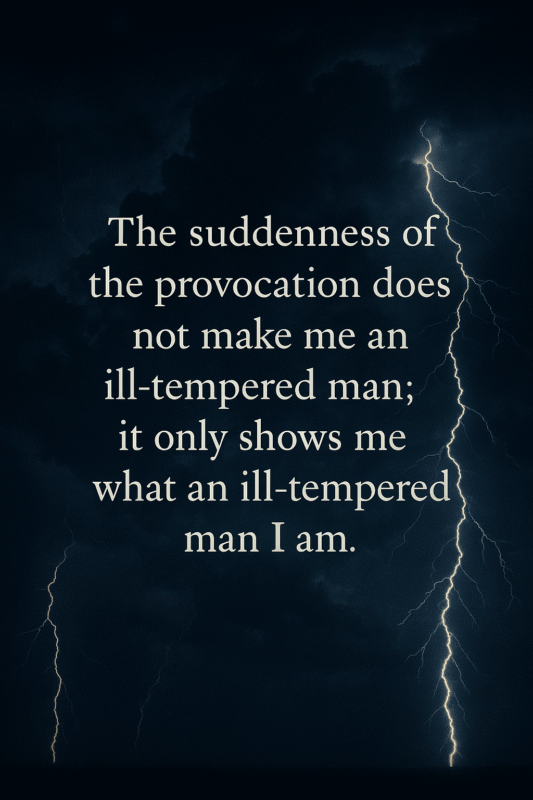
In the same way the suddenness of the provocation does not make me an ill-tempered man; it only shows me what an ill-tempered man I am.
The rats are always there in the cellar, but if you go in shouting and noisily they will have taken cover before you switch on the light.
C.S. Lewis, Mere Christianity
What Lewis observed in metaphor – that sudden light reveals, rather than creates, what was already there – has echoes in contemporary science. Modern psychologists and neuroscientists show that our quick reactions under pressure aren’t signs of arbitrary behavior, but deeply rooted reflections of our underlying traits, emotional habits, and regulatory capacities.
Modern research backs up Lewis’s point in surprising ways. For example, a study published in Behavioural Pharmacology in 2014 found that during lab stress tests, people high in negative emotionality reacted with sharper distress, while those with more communal traits stayed calmer, showing lower cortisol and steadier blood pressure. Another line of work, reported in the Journal of Abnormal Psychology in 2015, showed that provocation lights up different parts of the brain depending on whether someone leans toward aggression or self-control – the traits are there all along, only revealed under pressure.
A long-term study in the Journal of Personality in 2005 tracked how small frustrations played out: some people swallowed them, others flared up, and the difference mapped closely to personality. The science points the same direction as Lewis’s metaphor: pressure doesn’t create a new self – it unmasks the one already there.
Can We Reshape What Pressure Reveals?
We can read this and shrug off our temperament as inevitable, or we can take the insight as a chance to grow. Temperament predisposes us to certain responses, but habit reshapes our behavior.
When we say we want to change, we usually mean a mix of things: fewer spikes when we’re caught off guard, a steadier baseline over time, and a way of acting that lines up with what we say we value across a wide variety of circumstances. We can’t swap out our wiring (although neuroplasticity is a thing), but we can train what it tends to do. Attention, for our brains, is nutrition – what we feed grows, and neural paths that we train ourselves to use will start to become our automatic response. Our brains and bodies learn, even well into adulthood.
Progress in the cellar is easy to miss because the signs lag (this brings to mind seasonal lag). Old responses will continue to creep in when you’re worn down – that isn’t failure so much as the reality of being human. And we can turn that same kindness we want outwardly displayed inward as well – not beating ourselves down with shame but instead compassionately acknowledging the difficulties that we face while aiming to do better.
Prayer and Fasting – Changing the One Who Prays
Prayer trains our attention toward God and good, and sets the stage for our automatic responses to be grounded in our values – gratitude shifts what we notice, confession softens our instinct for harsh defensiveness, praying for those around us widens our scope of compassion. Even if you aren’t sure how much prayer changes the world around you, it is well documented that it changes the world within you – and that, in turn, will change the world around you either way.
Fasting is a chosen limit that creates room to practice how we respond when our conditions are less than ideal – not a way to loudly proclaim our self-righteousness (or it shouldn’t be, at least), but a quiet method of loosening our dependence on comfort and convenience so that our priorities can be straightened out. For some (with certain medical conditions, for example), food shouldn’t be on the table at all; non-food fasts count just as much. In historic and broader Christian language, it’s a type of watchfulness and openness – grace meets effort. Our overall life circumstances may not budge, but we, the ones who meet them, can grow more patient, more available, more whole. We can discover peace that goes beyond what we initially thought possible.
Befriend the Light in our Cellars
When someone suddenly bursts into the cellar of our souls and turns on the light, it doesn’t conjure rats out of the void – it shows us what we’ve been feeding. The good news is we can change, not by emptying our cellar but by filling it with the good that we value. With patient practice – prayer, fasting, attention, and small daily choices – the cellar starts to look different. Then the next time a sudden provocation comes, our response might surprise us a little less – perhaps instead it will reveal the person we’ve been quietly training to become.
Discover more from inquiring life
Subscribe to get the latest posts sent to your email.